An AI business recommendation is assembled from what's publicly written about a business — chiefly its reviews and its Google Business Profile. Four findings from the past year, read together, tell a story most owners haven't heard yet: customers moved to AI for recommendations faster than any channel shift in recent memory, the AI shortlist is brutally small, the data behind it is often wrong, and the review behaviours customers reward are the same ones the machines can read.
Key takeaways
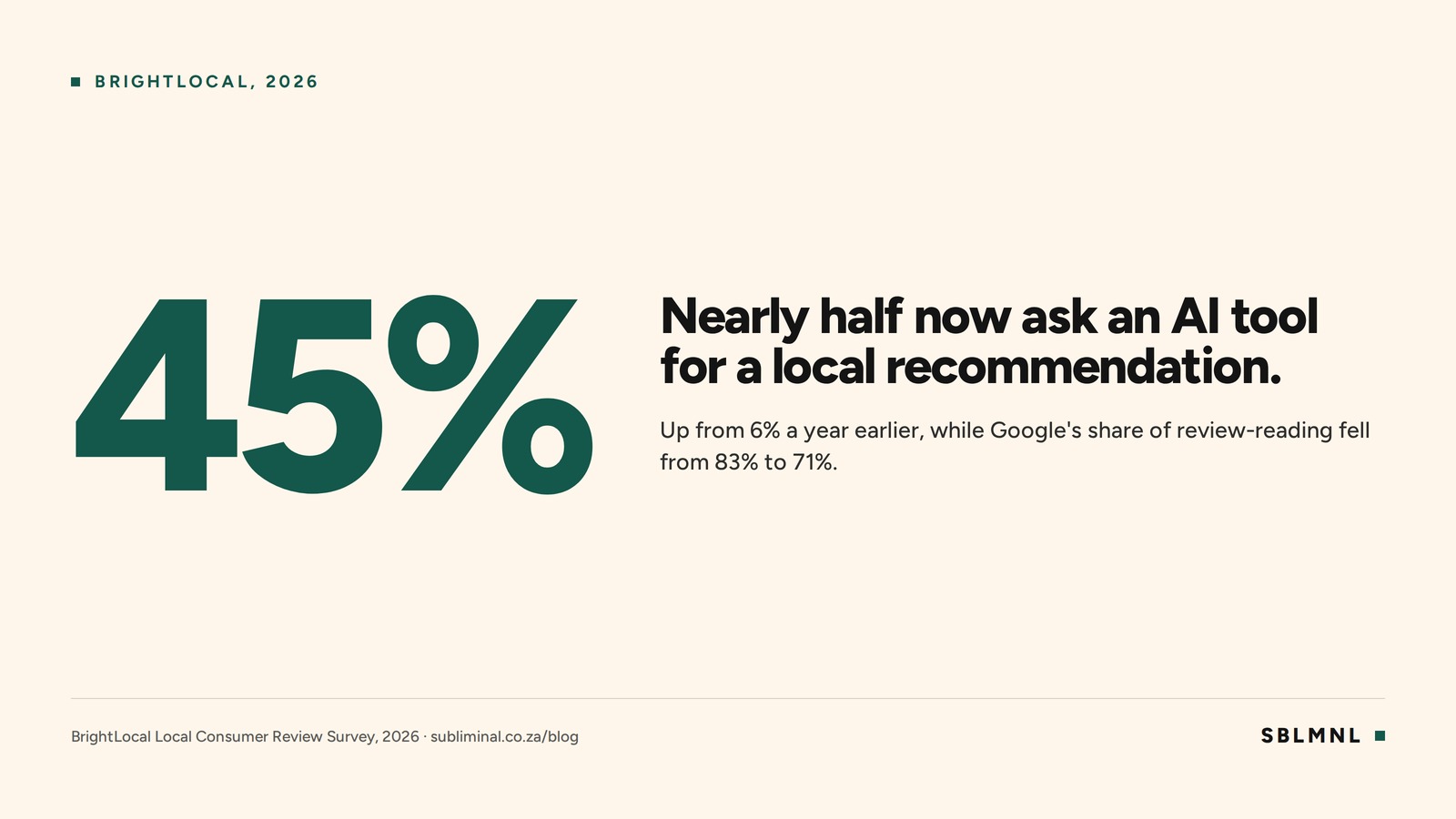
- Use of ChatGPT and similar AI tools for local recommendations rose from 6% to 45% in a year in BrightLocal's 2026 survey, while Google's share of review-reading fell from 83% to 71%.
- By one industry analysis of 350,000+ locations, ChatGPT recommends about 1.2% of business locations, against 35.9% appearing in Google's local 3-pack, and the locations ChatGPT recommends average 4.3 stars.
- The same analysis found business-profile accuracy of roughly 68% on ChatGPT and Perplexity, against effectively complete accuracy on Gemini, which draws directly from Google Maps.
- 82% of consumers read AI-generated review summaries; 23% would rely on the summary alone.
- Replies are part of the record: 80% are more likely to use a business that responds to all its reviews, while generic, templated replies make half of consumers less likely to choose one: worse than not replying at all.
Where the recommendation question moved
Start with the customer. In BrightLocal's 2026 Local Consumer Review Survey (1,002 US consumers), the share using ChatGPT or similar AI tools for local recommendations rose from 6% to 45% in a single year, making AI the third most popular source, while Google's share of review-reading eased from 83% to 71%. A jump that large in one survey deserves its hedge: it is one panel, one year. But the direction matches what the platforms themselves report, and 42% of the same respondents now say they trust AI recommendations as much as traditional reviews.
The review record follows the customer into the new surface. 82% say they read AI-generated review summaries; 23% would rely on the summary alone. Your reviews are no longer only read one by one — they get digested, summarised, and repeated by machines.
The shortlist is shorter
Traditional local search is generous: dozens of businesses rank somewhere. AI recommendation is not. In SOCi's 2026 Local Visibility Index (an analysis of more than 350,000 locations across 2,751 brands), ChatGPT recommended roughly 1.2% of locations, Perplexity 7.4%, Gemini 11%. The same brands appeared in Google's local 3-pack 35.9% of the time. And there is no page two of an AI answer: a business is in the response, or it doesn't exist for that customer.
One detail in the study lands close to home for reputation work: the locations ChatGPT does recommend average 4.3-star ratings. That's a description of the recommended, not a formula for being recommended, but it fits everything else we know about what these systems read.
The AI is often wrong about you
Here's the finding that should bother owners most. The same SOCi analysis put business-profile accuracy at about 68% on ChatGPT and Perplexity: roughly a third of profiles carrying wrong details (hours, locations, attributes), delivered in a confident voice. Gemini, which draws its business data directly from Google Maps, came out effectively complete.
The practical lesson sits in that contrast. Where the AI is grounded in well-maintained source data, it gets businesses right; where it isn't, it improvises. You can't edit ChatGPT. You can keep the record it learns from accurate and current, which is precisely the discipline of Google Business Profile Management: correct categories, current hours, active updates, a profile that reads the same everywhere it's syndicated.
Your replies are part of the record
The second manageable input is how you respond to reviews. Consumers reward it directly: in BrightLocal's survey, 80% are more likely to use a business that responds to all its reviews, and 89% expect owners to respond. The same survey carries a warning for anyone tempted to automate the caring: templated, generic replies make 50% of consumers less likely to choose a business, a worse result than the 42% deterred by no reply at all. A machine-written thank-you is visible to everyone, including the machines.
What produces that kind of record is unglamorous. Ask every customer, reply to every published review with something specific rather than templated, and let the rating settle where it settles. The record that builds reads as credible to a careful person, and it is the same record the machine is working from.
What to do about it, honestly
All of this is US-measured: the trend line, not a local statistic. We don't claim South African figures nobody has collected, and the conditions that produced these numbers (a dominant Google, customers who read reviews) are already local facts. There is also no AI placement to buy. What a business controls are the inputs: a profile that's accurate everywhere, a review record that's genuine, current and growing, and responses written by someone who was actually there. Manage those and you've done what can honestly be done, for the search results customers see today and the AI answers more of them consult tomorrow.
Frequently asked questions
Do AI assistants use reviews when recommending businesses?
Yes. Review data is among the public evidence AI assistants draw on when assembling a recommendation, and consumers meet it from the other side too: in BrightLocal's 2026 survey, 82% of consumers said they read AI-generated review summaries, and 23% would rely on the summary alone rather than reading individual reviews.
How many businesses do AI assistants actually recommend?
Far fewer than traditional search shows. By one industry analysis of more than 350,000 locations (SOCi's 2026 Local Visibility Index), ChatGPT recommended about 1.2% of locations, Perplexity 7.4% and Gemini 11%, while the same brands appeared in Google's local 3-pack 35.9% of the time.
Is the information AI assistants have about my business accurate?
Often not. The same SOCi analysis put business-profile accuracy at roughly 68% on ChatGPT and Perplexity — around a third of profiles carrying wrong details — against effectively complete accuracy on Gemini, which draws directly from Google Maps. Keeping the source data accurate, starting with your Google Business Profile, is the practical defence.
Can I pay to be recommended by an AI assistant?
No. There is no placement to buy in an AI assistant's organic recommendations. What a business can manage are the inputs the assistants read: an accurate, active business profile, a genuine and current review record, and considered responses to reviews. None of that guarantees a recommendation — it makes a business readable and credible to the systems doing the recommending.
What does the machine currently read about you?
Most owners have never seen their business the way an assistant does. Ask one to recommend a business in your category and your area, then search yourself logged out on a phone. The gap between those two answers is usually the whole story. Keeping that record accurate is the job of Google Business Profile Management.